Torus palatine: what is it, symptoms and when controlled | Dentistry study Stere
Torus palatine: what is it, symptoms and when controlled | Dentistry study Stere
The torus palatino is a benign bone protuberance that develops on the middle line of the hard palate. It can be discovered by chance by passing the language on the palate or during a dental visit and, when it maintains typical characteristics, it often does not cause disturbances or requires treatment.
A hard protrusion in the mouth, however, should not be identified only by a photograph or by comparison with online images. Seat, texture, surface, time and mucosa conditions help the professional to distinguish a torus from other alterations that may require a different path.
For those looking for information about torus palatino in Lecce, this guide explains what signs to observe, when control can be sufficient and in what situations an evaluation is useful. The Studio Odontoiatrico STERE welcomes patients from Lecce, Salento and Puglia in Via Giovanni Boccaccio 19 C/D/E.

What is the torus palatino
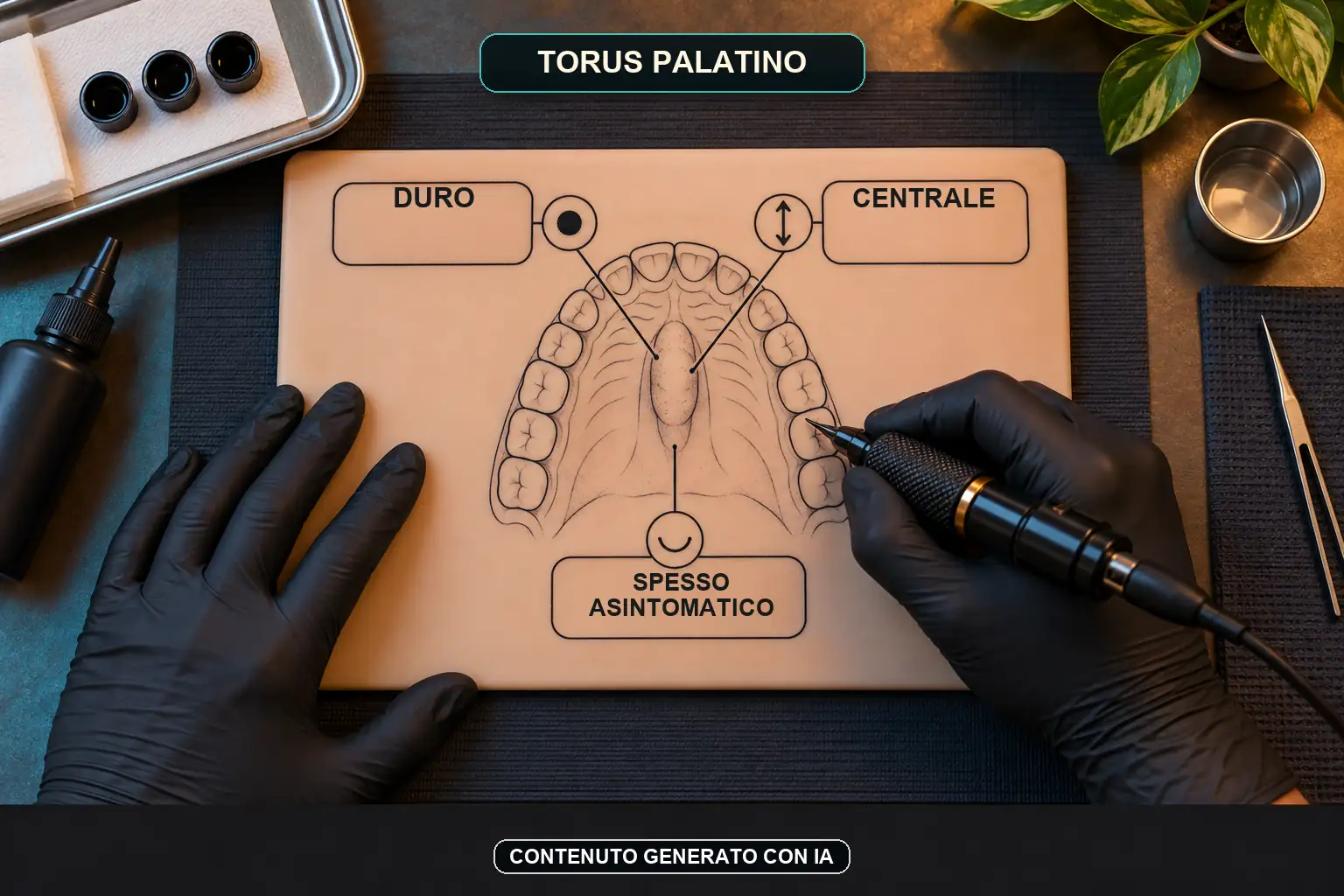
The torus palatino, also called toro palatino, is an exostosis: a growth of mature bone that forms more often in the center of the hard palate. The Cleveland describes it as a benign and non-carcinogenic condition, generally recognizable for the harsh consistency and characteristic position.
It can be presented as a unique relief, elongated or subdivided into multiple lobules. Size and profile vary from person to person; the only size does not automatically determine if it should be removed. It mainly counts the relationship with the mucosa, with the function and with any prosthetic devices.
The torus consists of bone and not a collection of liquid or a gum swelling. This distinction explains why the touch is very hard, but does not authorize self-diagnosis: the location and history of injury must also be evaluated.
How can you present yourself in the palate
Position and consistency
The most typical location is along the central line of the hard palate, behind the upper teeth. The relief is still and hard because it is part of the bone structure. A lateral, mobile or soft mass does not correspond to the classic description and deserves a frame without attributing a name immediately.
Thin mucosa and small traumas
The mucosa that covers the torus can be thin. Hard, crisp or very hot clouds and edges of a prosthetic can irritate it, causing a small painful injury. In these cases the discomfort often depends on the traumatized coating, not on the bone itself.
Slow and individual variability
A typical torus tends to change slowly. Some people have it for years without noticing it; others perceive that it occupies more space or interferes with language and nutrition. Note when it has been noticed and report real changes helps control, while constantly measuring it with objects can irritate the area.
Torus palatine and other protuberances are not the same thing
Soft, red or soft swellings
A swelling related to inflammation, infection, salivary glands or soft tissues may have different texture, color and seat. The MSD Manual for Professionals remember that oral cavity neoformations include benign conditions and alterations requiring verification: clinical examination serves to avoid labels based only on appearance.
Changes that require attention
A lesion recently appeared, which grows rapidly, bleeding, has an ulceration that does not heal, changes color or causes persistent pain should not be given for granted as torus. Also new difficulties in talking, swallowing or wearing a prosthesis are reasons to request an evaluation.
A small trauma ulcer should be controlled if it does not improve after removing irritation. To deepen the differences between common ulcerations and lesions to be evaluated is also available the STERE guide on afte and mouth ulcers.
Why the torus palatino appears
The precise cause is not defined in each person. Clinical sources describe a possible combination of individual predisposition, hereditary characteristics and mechanical stress over time. It is therefore not correct to attach it with certainty to a single food, a deficiency or a specific habit.
The torus does not appear because the teeth were cleaned badly and is not an inevitable consequence of bruxism. Chewing and tightening forces are studied among the possible associated factors, but an association does not demonstrate an individual cause. If there is wear, tension or mandibular pain, these aspects are evaluated separately.
There are no exercises, massages or home products that can dissolve bone growth. The aim of control is to confirm the nature of the relief, monitor it when appropriate and protect the mucosa from trauma.

How the dental evaluation takes place
Clinical examination and history of relief
The professional looks at position, shape, symmetry, color of the mucosa and texture, so asks when the relief was noticed and if it has changed. Pain, repeated trauma, functional difficulties, presence of prostheses and other alterations of the mouth.
Imaging or deepening only when indicated
A torus with classic features can be clinically recognized. Radiographs, three-dimensional imaging or other tests are not automatic: they are chosen only if they can respond to a diagnostic doubt or contribute to the planning of any intervention. The Studio has routes of 3D diagnostic imaging, to be used when the clinical question justifies it.
If appearance, location or trend are not typical, the dentist may indicate a deepening or sending to the competent professional. A photograph can document the evolution, but does not allow to evaluate texture, depth and surrounding structures.
When removal can be evaluated
Functional interference, trauma or prosthetic project
Removal is not necessary for each torus. It can be discussed when the relief suffers repeated wounds, interferes significantly with word, chewing or swallowing, or prevents the correct design and stability of a removable prosthesis. Also a diagnostic doubt can change the path.
Intervention is a surgical procedure and requires evaluation of size, shape, thickness of tissues, general health and clinical objective. Benefits, limits, risks and course are explained before deciding; it is not possible to establish indication and technique from a photo sent remotely.
If the torus is asymptomatic and does not create obstacles, periodic control can be sufficient. "Wellness" does not mean to ignore any future change: a new ulceration or unusual variation should be reported.

What to do at home and what mistakes to avoid
It is useful to maintain normal oral hygiene with appropriate tools, without aggressively rubbing the relief. If the mucosa is irritated, temporarily avoiding sharp foods, very hot or particularly hard can reduce additional traumas while waiting for control.
Do not attempt to wash, engrave, limate or crush protuberance. A torus is bone and these maneuvers can cause injuries and infections without changing the cause. Also caustic substances, concentrated alcohol or abrasive remedies can damage the mucosa.
A prosthesis should not be adapted independently. Take it to the visit allows you to check the pressure points and understand whether it is sufficient to correct the device or if the torus really interferes with the prosthetic project.
Evaluation of torus palatino at Studio STERE di Lecce
At the Studio Odontoiatrico STERE, in Via Giovanni Boccaccio 19 C/D/E in Lecce, the evaluation of a protuberance of the palate starts from clinical examination and related history. The aim is to distinguish a typical bone repertoire from alterations requiring different controls, avoiding unjustified examinations or procedures.
Dr. Nicolò Stefanelli and Dr. Rosanna Renò have matured more than ten years of experience in the dental sector in Italy; the staff of Studio STERE has been working for over ten years. The path is explained in understandable language and adapted to the clinical data really available.
Among the verified services of the Firm is also the orthodontics with transparent aligners; Invisalign is one of the systems used when indicated after the evaluation of Dr. Lorenzo Garrisi, dentist specialist in Orthodontics. This service does not constitute a treatment of torus: the reference serves to correctly describe the verified offer of the Studio without confusing different areas. Information and contacts are available on Scholarship. it.
Frequently asked questions about torus palatino
Is palatine torus a tumor?
The typical palatine torus is a benign and non-carcinogenic bone growth. A mass of the palate should not be called torus without evaluation: unusual position, rapid growth, bleeding, persistent pain or ulceration that does not heal require control.
Can shovel torus hurt?
It often doesn't hurt. The discomfort can appear when the thin mucosa that covers it is traumatized by food, prostheses or other contacts. Spontaneous or persistent pain deserves an evaluation to exclude different causes.
Does the palatine torus keep growing?
It can change slowly over time, but the trend varies. A rapid increase does not correspond to the typical behavior and should be checked. Occasional comparisons or dated photographs may be useful; repeated manipulations may not.
Do you always need an X-ray?
No. Typical features can be recognised with clinical examination. Imaging is considered when there is a doubt, when studying nearby structures or when planning a procedure.
Should the torus palatino always be removed?
No. In the absence of symptoms, recurring traumas, functional interference or prosthetic problems can be sufficient to monitor it. The decision derives from the individual budget between the usefulness of the intervention and its course, not from the sole presence of the relief.
At Studio Odontoiatrico Stere you can find a complete range of preventive and curative dental treatments.
If you are looking for a dentist in Lecce to improve oral hygiene, prevent caries and gum inflammations or choose home products that suit your needs, the Studio Stere team can accompany you with a customized evaluation. Learn more about Scholarship. it and book your visit to control.
Read more important articles here: Blog
Visit the official website: Study Stereo
Come and visit us: Via Giovanni Boccaccio 19 C/D/E – Lecce
Contact us now for an evaluation.
Follow us on our social media:
Article written by Dr. Nicolò Stefanelli – Dentistry
"Take Care"
– Studio Stere –
Continue reading
Conoid lateral incisive: how to assess shape, space and restoration | Dentistry study Stere
Pulpotomy in the adult permanent tooth: when to store part of the pulp | Dentistry study Stere
Tooth moved after a shock: because lust requires an urgent visit | Dentistry study Stere
Odontoma: when an obstacle prevents a tooth from popping | Dentistry study Stere