Retainer after the device in Lecce: how much to carry it and why the teeth can move | Dentistry study Stere
Retainer after the device in Lecce: how much to carry it and why the teeth can move | Dentistry study Stere
The day the device is removed or the last phase with the transparent liners may seem to be the final finish. The teeth are aligned, the smile has changed and the most challenging part of the path appears ended. In reality, at that moment begins a less visible but fundamental phase: orthodontic containment.
The retainer, also called containment device, is used to help maintain the position reached by the teeth. Without proper protocol, dental elements can gradually change their alignment. This phenomenon is called orthodontic relapse and does not necessarily depend on an error in treatment: the mouth continues to change over time and each patient has different characteristics.
At Studio Odontoiatrico Stere di Lecce, the containment path is defined according to the treatment performed, the position of the teeth, the occlusion and the individual needs. The study continues to welcome patients throughout the summer, even during the month of August, for orthodontic checks and retainer evaluations at Via Giovanni Boccaccio 19 C/D/E in Lecce.

What is retainer and why is it used after the appliance?
The retainer is a device made to maintain the teeth in the position reached at the end of the active phase of the orthodontic treatment. It can be removable, fixed or inserted into a protocol that combines both solutions.
The British Orthodontic Society indicates containment as an essential part of most orthodontic treatments. The teeth can in fact tend to move towards previous positions and, over the years, additional natural changes of alignment may occur.
The retainer is therefore not an optional addition or a simple accessory. It is part of the orthodontic plan and requires collaboration, controls and maintenance. Its function is not to ensure that the teeth remain still forever, but to help reduce the risk of unwanted movements according to the indications received.
Why can teeth move after treatment?
At the end of the appliance, the teeth are in a new position, but they continue to be subjected to the forces of chewing, muscles, tongue and surrounding tissues. Growth, ageing, occlusion and some individual features can also affect stability over time.
Not all movements have the same entity and not all patients have the same risk of relapse. Initial position of teeth, correct rotations, crowding, spaces, gum conditions, oral habits and type of treatment may contribute to the choice of containment protocol.
Does the retainer permanently block any movement?
No. No device can guarantee absolute and permanent stability. One systematic revision of fixed retainers has evidenced that there is no system capable of ensuring in any case the perfect maintenance of alignment. This is why correct use and periodic controls are important.
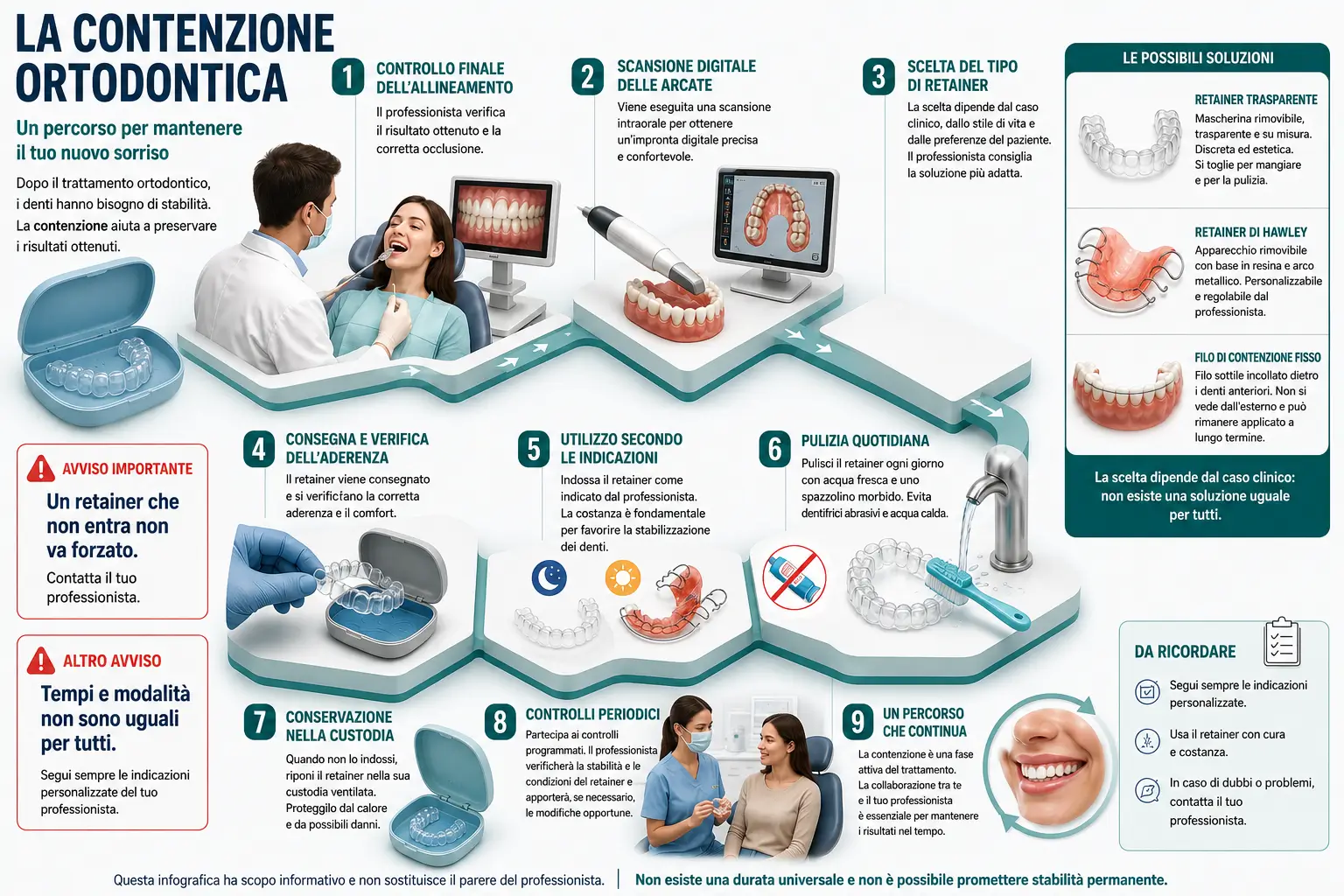
What types of retainers exist?
The main containment devices are the removable transparent retainer, the Hawley retainer and the fixed retainer. The choice depends not only on aesthetic preferences: the professional considers the interested arch, the movements performed, the occlusion, the health of teeth and gums and the ability of the patient to follow the indications.
Retainer transparent removable
It is a thin and transparent mask made on the shape of the tooth arches. It is removed to eat and to perform oral hygiene. Its discretion makes it a frequently used solution after fixed device or treatment with transparent alignments.
The retainer must adhere to the teeth without being independently modified. Do not eat with the mask inserted or expose it to high temperatures. Coloured, sweetened or very hot drinks can also alter the device or promote the accumulation of residues.
Retainer of Hawley
Hawley's retainer is removable and is generally formed by a resin part and a metal wire that passes in front of the teeth. It is resistant and can be adjusted in some situations, but can be more visible than the transparent mask. In the first days it can slightly affect pronunciation, with a generally progressive adaptation.
Retainer fixed or bonded retainer
The fixed retainer consists of a thin wire applied to the inner surface of the teeth, often in the front area. It should not be inserted or removed from the patient and remains little visible during the smile.
The main advantage is that it does not depend on the daily memory of wearing it. However, it requires careful hygiene around the thread and the adhesion points. If a part breaks, folds or causes an unusual feeling, it is necessary to request a control without attempting to settle it independently.
Retainer fixed and removable can be used together?
Yes, when indicated. In some cases the professional can recommend a fixed retainer associated with a removable mask. The combination is chosen according to clinical needs and does not mean that only one device is always insufficient.
Available searches show different advantages and limits between fixed and removable containment. One systematic review of clinical studies has found different results based on the arch and the observed period, confirming that there is no universally better protocol for all.

How long does the retainer take?
There is no identical duration for all. Frequency and time of use depend on the clinical case, device type, treated arch and path phase. Indications delivered by the professional must have priority over generic advice found online.
The first phase after removing the appliance
In the first months the containment may require more frequent use. The professional can indicate wearing the retainer removable every night or for a greater number of hours, depending on the situation. Reducing the use time itself can increase the possibility that the mask will begin to be narrower.
Long-term containment
With the passing of time, some protocols provide a gradual reduction of the frequency, however maintaining a prolonged night use. The orthodontics department Nottingham University Hospitals NHS Trust, for example, describes a protocol that passes from daily night use to alternate nights and continues long-term. It is an organizational example, not a valid prescription for each patient.
The British Orthodontic Society emphasizes that prolonged use can help maintain alignment longer. This does not mean that each person should follow the same calendar: duration and frequency must be defined and updated during checks.
Why can directions change over time?
The professional can change the protocol according to the adherence of the retainer, to the stability of the teeth, to the gum conditions, to the wear of the device and to the collaboration of the patient. A control also allows to verify that the fixed retainer is intact and that it is not interfering with oral hygiene.

What happens if you don't bring the retainer for a few nights?
Jumping one or more applications does not produce the same effect in each person. The retainer can continue to fit normally, be tighter or not completely adapt to the teeth. The answer depends on the stability reached and the time spent without using it.
The retainer enters, but seems narrower
A slight pressure may indicate that small changes occurred. You do not have to independently increase the hours of use beyond the received protocol or use the device as if it were an active liner. It is preferable to contact the study if the feeling persists, increases or appears pain.
The retainer does not enter completely
If the mask does not reach the correct position, it has obvious spaces or requires excessive pressure, it should not be forced. TheAmerican Association of Orthodontists We recommend that you contact the professional when the retainer continues to be uncomfortable or does not fit properly.
Force a deformed mask or no longer compatible with the arch can damage it and does not allow you to understand the cause of movement. An assessment may determine whether it is sufficient to replace the device or if further steps are needed.
Can the retainer straighten the teeth again?
The retainer is designed primarily to maintain a position, not to correct important shifts. In the presence of a mild relapse, the professional assesses whether the device can still be used. In the most obvious cases it may be necessary to plan a short orthodontic treatment or realize a new retainer, without improvising domicile solutions.
How to properly clean a removable retainer?
The device must be cleaned regularly to limit the accumulation of plaque, residues and odours. After removing it, it can be rinsed with fresh or warm water and gently cleaned with a dedicated toothbrush and neutral liquid soap, following the instructions received.
It is appropriate to avoid very hot water, because it can deform plastic. Too the toothpaste can be abrasive and make the surface of some masks more opaque. Specific cleaning products must only be used according to the manufacturer and professional instructions.
How to store the retainer?
When it is not worn, the retainer must be placed in its rigid, clean and aerated housing. Wrap it in a napkin increases the risk that it is accidentally thrown; leaving it free in a bag or on a table can favor deformations, contaminations or breaks.
The device should not be left close to heat sources, on the car dashboard, exposed to the sun or to the reach of pets. A deformed mask should not be heated or remodeled in the house.
How to clean a fixed retainer?
With the fixed retainer it is necessary to carefully cleanse the inner surface of the teeth, the gum margin and the space around the wire. Depending on the configuration, wire can be indicated with wire loop, slides or other tools shown by the professional.
Persistent gum bleeding, tartar accumulation, difficulty in cleaning or wire mobility require control. The fixed retainer should not be ignored only because it is not visible from the outside.

What to do if the retainer breaks, loses or breaks?
Retainer removable broken or deformed
A crack, a sharp edge, a deformation or a loss of grip can compromise the operation of the device. You do not have to apply glue, resins, boiling water or other DIY solutions. It is useful to retain the retainer and contact the firm to understand whether it can be controlled or should be replaced.
Retainer lost
When the device is lost, it is advisable to communicate it without waiting for the teeth to show an obvious shift. Based on the time spent and the situation of the arch, a new scan or footprint can be indicated to realize an updated device.
Detached retaining wire
If the fixed retainer is separated from one or more teeth, it should not be pulled, cut or repositioned independently. A partial detachment can also allow small movements not immediately visible. The professional will evaluate whether to repair, replace or remove the wire and whether to associate a removable containment.
Is the retainer different from the one after the fixture?
The containment principle is similar: maintain the result obtained after the active phase. However, the device can change for material, shape, thickness and mode of use. After transparent liners it is not always correct to continue to use indefinitely the last mask of treatment as retainer.
The last liner was designed as part of an active sequence, while the retainer is made for the maintenance phase. The professional determines when to deliver it, if to associate a fixed containment and with what frequency to wear it.
How is the containment planned at Studio Stere di Lecce?
The containment phase is scheduled before the end of the orthodontic treatment. The team evaluates the alignment achieved, the relationships between the arches, the gum conditions and the stability of the teeth. When indicated, it intraoral scanner allows you to acquire a three-dimensional digital model of the arches useful to the custom design of the device.
At delivery, adaptation, comfort and mode of insertion and removal are checked. The patient receives information on times of use, cleaning, conservation and signals to be reported. Later controls are used to evaluate both the retainer and dental alignment and tissue health.
Those who spend their holidays in Lecce, in the province or in Salento can request a control of the containment during August without having to wait for September, especially in case of retainer lost, broken, too narrow or partially detached.
Frequently asked questions about the retainer after the device
How long do you have to carry the retainer?
The duration is determined by the professional. In many protocols the use is more frequent in the first phase and then continues during the night for a long period. You do not have to stop or reduce your use independently because stability varies from person to person.
Can teeth move even after many years?
Yes, dental alignment can change over time to relapse and natural changes in the mouth. The retainer can help limit these movements, but it must be used and checked according to the indications received.
Is it better the fixed or transparent retainer?
There is no better solution. The fixed retainer does not depend on the patient's memory, but requires careful hygiene; the removable one facilitates the cleaning of the teeth, but must be worn with constancy. In some cases both are used.
Can you eat with the transparent retainer?
Not usually. The removable retainer must be removed during meals, except for different directions. Eating with the mask can damage it, stain it and promote the stay of residues in contact with the teeth.
Why did the retainer become tight?
It can depend on irregular use, small dental movements or deformation of the device. If it does not adhere completely, it causes pain or requires strength to be inserted, it is necessary to request an evaluation.
How much should retainer be replaced?
There is no deadline for all. Wear, cracks, loss of transparency, deformations, changes of the arch and quality of the adhesion are evaluated during the controls. An intact device can still not be more suitable if the teeth have moved.
What happens if the fixed wire comes out of one tooth?
A limited detachment must also be checked. The thread may still appear present but no longer exercise the function provided on that tooth. You don't have to pull it or paste it into the house.
Should the retainer be checked even if it doesn't bother?
Yes. A fixed retainer can loosen without causing obvious symptoms and a removable mask can gradually wear. The controls allow to evaluate device, hygiene, gums and teeth position.
Where to request a retainer check in Lecce?
At Studio Odontoiatrico Stere, Via Giovanni Boccaccio 19 C/D/E in Lecce, it is possible to request an evaluation of the containment after fixed device or transparent aligners. For information, please consult page Contact.
At Studio Odontoiatrico Stere you can find a complete range of preventive and curative dental treatments.
If you are looking for a dentist in Lecce to improve oral hygiene, prevent caries and gum inflammations or choose home products that suit your needs, the Studio Stere team can accompany you with a customized evaluation. Learn more about Scholarship. it and book your visit to control.

Read more important articles here: Blog
Visit the official website: Study Stereo
Come and visit us: Via Giovanni Boccaccio 19 C/D/E – Lecce
Contact us now for an evaluation.
Follow us on our social media:
Article written by Dr. Nicolò Stefanelli – Dentistry
Continue reading
Imperfect Dentinogenesis: Protect teeth that are consumed soon | Dentistry study Stere
Orthodontic Minivitis: why they serve and how to follow them over time | Dentistry study Stere
Sjögren and oral health: organizing prevention with caregivers | Dentistry study Stere
Conoid lateral incisive: how to assess shape, space and restoration | Dentistry study Stere