Dental implants with surgery guided in Lecce: the future of implant dentistry
Dental implants with surgery guided in Lecce: the future of implant dentistry
The dental implants with guided surgery represent one of the most important evolutions of modern implant dentistry. When one or more teeth are missing, implant rehabilitation can help recover chewing function, smile aesthetics and prosthetic stability, always after an accurate assessment of the clinical case. Today, thanks to digital planning, it is possible to study the surgery before the surgical phase, evaluating bone, gum, position of neighboring teeth and future prosthesis.
At the Studio Odontoiatrico Stere di Lecce, the implant path is carefully set diagnostics, digital technologies and custom planning. The Dr. Nicolò Stefanelli, Dr. Rosanna Renò and the team evaluate each patient individually, because not all cases are equal and not always the same technique is indicated for everyone.
Talk about implant surgery in Lecce means talking about an approach that combines clinical experience, three-dimensional images, planning software and personalized surgical guides. The aim is to make implants more programmed, controlled and consistent with the final prosthetic project.
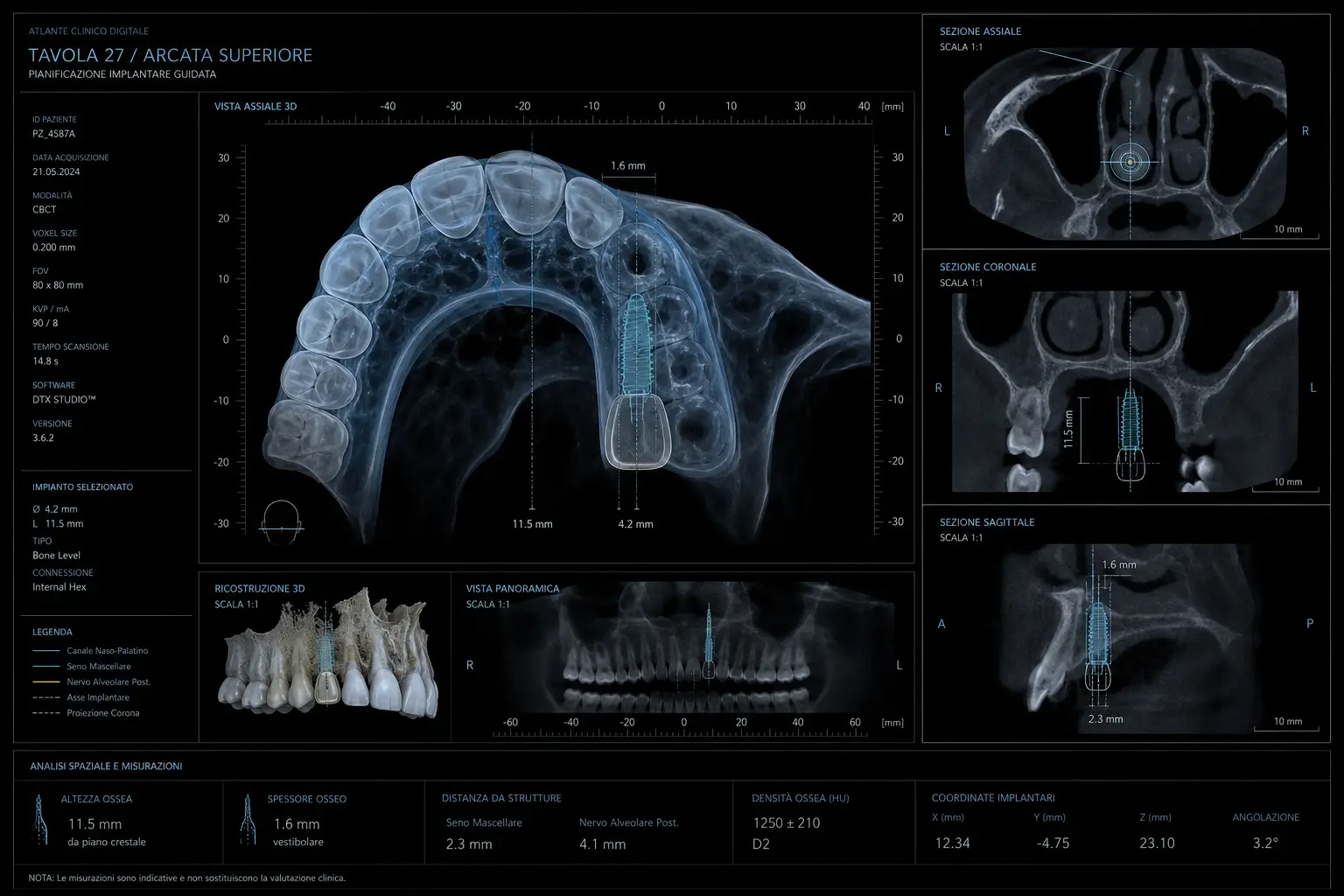
What are dental implants
Dental implants are devices, generally titanium or biocompatible materials, designed to replace the root of a missing tooth. Once inserted into the bone, the implant can support a crown, bridge or prosthesis, depending on the number of teeth to be rehabilitated and the patient’s clinical situation.
Dental implantology is not only about the insertion of a screw in the bone. It is a path that includes diagnosis, mouth study, available bone assessment, gum health, oral hygiene, occlusion, aesthetic expectations and prosthetic project. For this reason, before talking about implantation, it is essential to understand whether the patient is really suitable and what treatment can be more suitable.
The lack of a tooth is not only an aesthetic problem. It can influence chewing, load distribution, the location of neighboring teeth and the quality of everyday life. A well-planned implant rehabilitation can help restore balance and function, but must always start with a careful clinical evaluation.
What is implant guided surgery
The implant guided surgery is a technique that uses digital planning to program the location of dental implants before surgery. Through three-dimensional diagnostic tests, such as the TAC Cone Beam when indicated, and specific software, the dentist can study the patient's anatomy and virtually simulate implant placement.
This planning allows you to evaluate depth, inclination and position of the implant compared to the available bone, the nearby teeth, the gum tissues and the future prosthesis. In this way, the surgery is not only dealt with from the surgical point of view, but also according to the desired prosthetic result.
After digital planning, a personalized surgical guide can be realized. This is a mask designed to help the clinical during implant placement, following the project established in the digital phase. The guide does not replace the professional experience, but represents a tool to support operational precision.
Guided surgery does not mean automatic surgery
It is important to clarify a point: guided surgery is not an automatic procedure and does not eliminate the need for clinical experience. The software helps to plan, the guide helps to transfer the plan to the mouth, but the dentist's assessment remains central at every stage. Anatomy, bone quality, gums, oral hygiene and general conditions of the patient must always be considered.
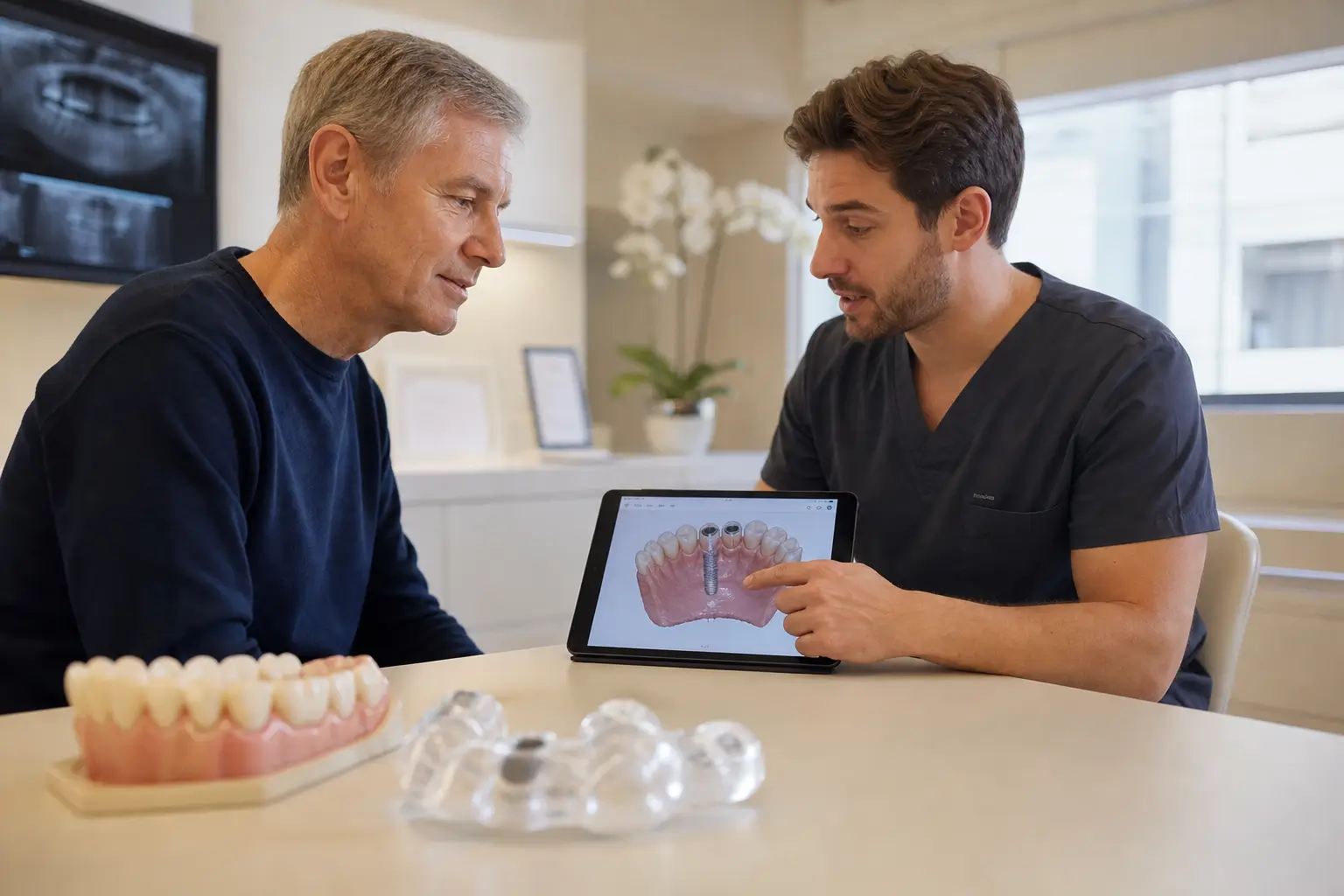
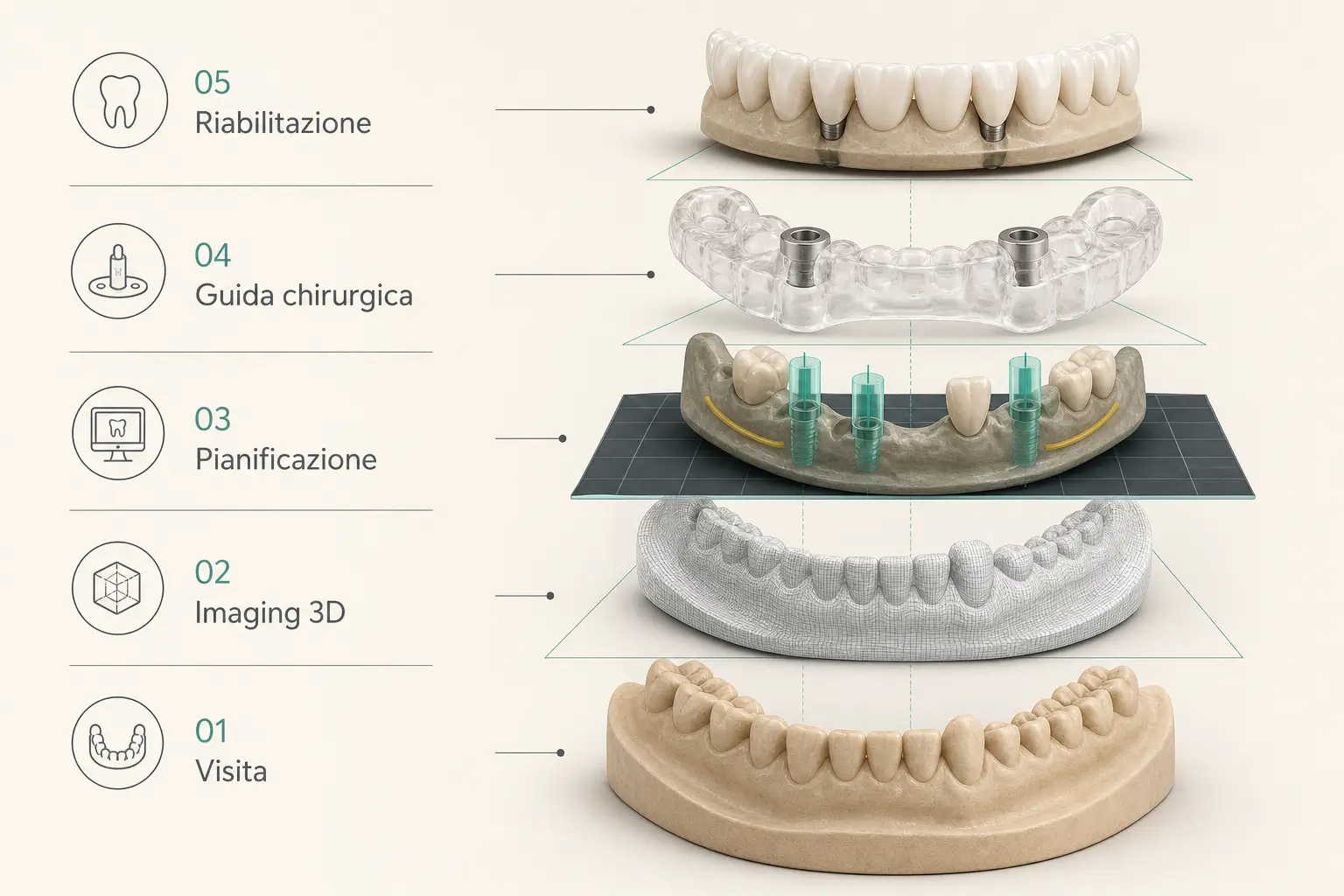
How the guided implantology path works
The route begins with a dental visit. During this phase the state of the mouth, the presence of missing teeth, the quality of the tissues, any infections, gums, periodontitis, old restorations and patient habits are evaluated. Before entering a plant, it is essential that the mouth is in conditions compatible with the treatment.
When the case requires it, a three-dimensional radiographic study is performed. The3D diagnostic imaging allows to observe the bone in more detail than a two-dimensional X-ray, evaluating height, thickness, close anatomical structures and areas requiring greater attention.
Subsequently, data is integrated into a planning software. The dentist studies the ideal location of the implant, considering not only the available bone, but also the future crown or prosthesis. This is a fundamental step: a plant must be positioned in a manner consistent with the final project, not only where there is more bone.
Custom surgical guide
When planning is completed, a tailor-made surgical guide can be realized. This mask is designed on the basis of patient anatomy and digital implant plan. During the operation, the guide helps to respect the position, inclination and depth provided, within the limits of the actual clinical situation.
The role of implantation
Guided surgery is closely linked to the final prosthesis. The goal is not only to insert a system, but to create conditions for functional and aesthetic rehabilitation. This is why we often talk about implantology "protectively guided": the position of the implant is studied also thinking of the tooth that will have to replace.
What are the advantages of guided surgery
Guided surgery can offer several advantages in the cases indicated. The first is the possibility to plan the intervention with greater detail. Studying the case before surgery allows to evaluate spaces, bone volumes, inclinations and relationship with neighboring anatomical structures.
Another advantage is the greater organization of the route. The patient can better understand the phases of the treatment, while the clinical can program the surgery starting from a digital project. This can help make the procedure more controlled and consistent with final rehabilitation.
In some selected cases, guided surgery can allow a less invasive approach than traditional techniques, but this always depends on the clinical case. It is not correct to promise reduced engravings, faster healing or lack of discomfort to all patients, because each mouth responds differently.
Accuracy in planning
Digital planning allows you to study implant placement in advance. This can be particularly useful in cases where space is limited, the available bone should be carefully evaluated or the aesthetic area requires great precision.
Increased route predictability
Guided surgery can help make the path more predictable from the organizational and design point of view. Knowing first where the plant will be placed helps to set the treatment more neatly.
Support for communication with the patient
Digital images and planning can help the patient better understand the treatment. Seeing the implant project, when possible, makes clearer steps, objectives and limits of the procedure.
Is guided surgery suitable for everyone?
No. Guided surgery is an advanced technique, but it is not automatically indicated for each patient. Before choosing this approach, the dentist must evaluate several factors: quantity and quality of bone, gum health, oral hygiene, presence of infections, habits such as smoking or bruxism, general health conditions and type of rehabilitation necessary.
In some cases, guided surgery can be an important support. In others, a traditional technique or a different path can be more indicated. Technology should not be used because "modern", but because it is really useful for that patient and for that treatment plan.
At the Dentistry Studio Stere, the evaluation is precisely to understand what approach is most suitable. The choice is not made standard, but after diagnosis, case study and comparison with the patient.
Dental and bone implants available
One of the most important aspects in implantology is the amount of bone available. After the loss of a tooth, the bone can be reduced over time, especially if the dental lack has been present for many years. This can affect the possibility of inserting a plant in the ideal location.
3D imaging allows you to observe volume and shape of the bone, evaluating whether the implant can be inserted directly or if additional procedures are required. In some patients a regenerative path may be indicated; in others, a different implant solution, always based on diagnosis.
Guided surgery can help you make better use of diagnostic information, but it does not create bone where it is not. This is why it is important not to confuse technology and clinical indication: digital planning is a tool, while the therapeutic decision remains medical and personalized.
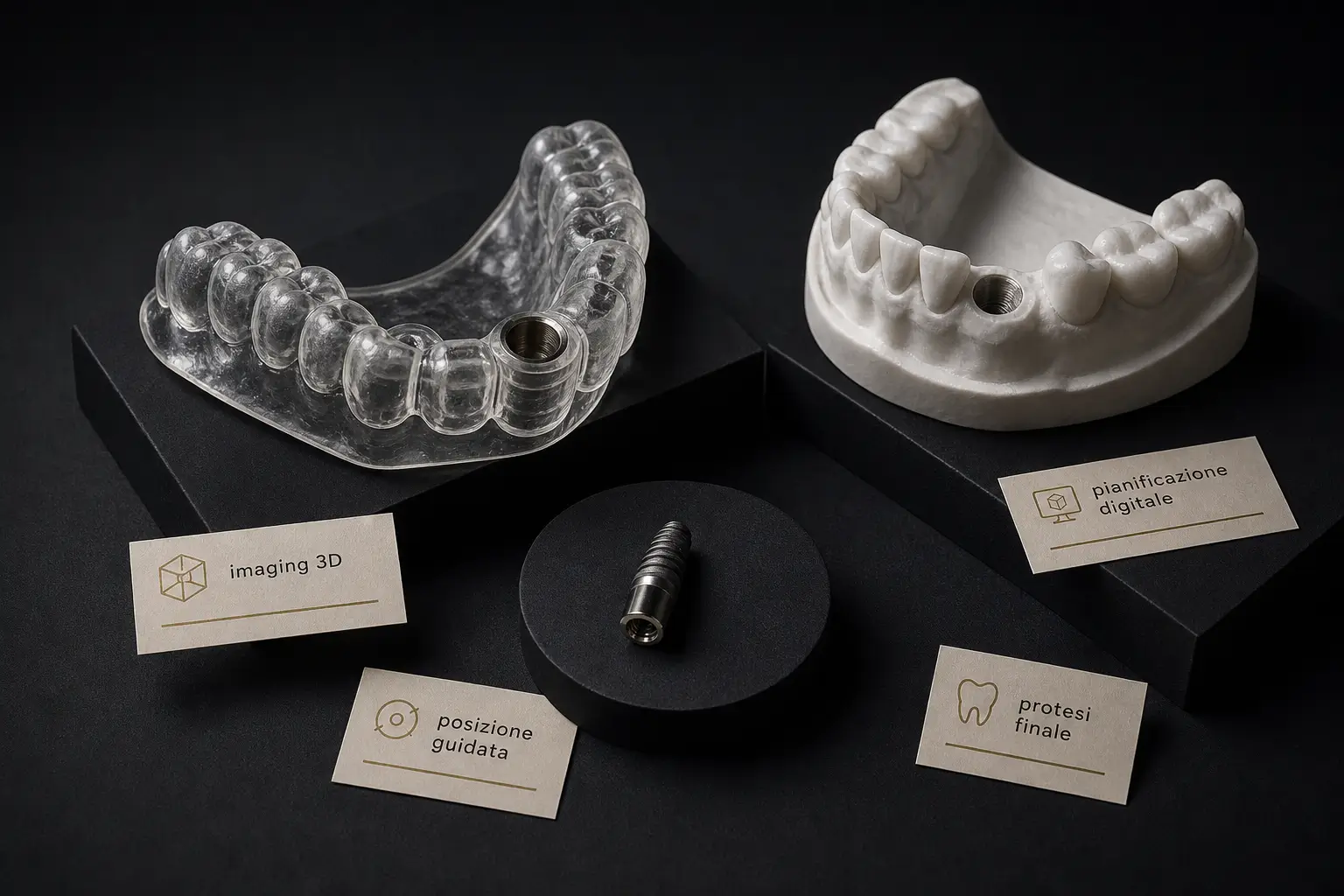
Dental, aesthetic and function systems
A dental implant must be integrated with the smile, but also with chewing. Position, inclination and depth influence the future crown, the shape of the gum, the ability to clean correctly and the distribution of loads. This is why modern implantology looks at the final result from the planning stage.
In the anterior sectors, aesthetics require special attention. The color of the gum, the tooth profile, the symmetry and the position of the gum margin are important elements. In the rear sectors, the chewing function and the stability of the prosthesis play a central role.
Guided surgery can be useful precisely because it connects diagnosis, surgery and prosthesis. This approach allows you to program the treatment more fully, avoiding considering the plant as an isolated element.
What to expect after guided implant surgery
The course after implantation depends on many factors: number of implants inserted, treated area, bone quality, any additional procedures, patient conditions and complexity of the case. Some interventions may have a simpler post-op, while others require more attention and close controls.
After surgery, the patient receives precise indications about hygiene, nutrition, medications if prescribed, behaviors to avoid and subsequent controls. Follow the instructions correctly is essential to favor an orderly healing and reduce the risk of complications.
It is important to remember that the plant is not a natural tooth and requires maintenance. Even after healing, periodic controls and professional hygiene are essential to monitor gums, bone, prostheses and stability over time.
Maintenance of dental implants
A dental implant must be carefully cleaned. Plate and bacteria can accumulate around implant prostheses and gum tissues, causing inflammation. For this reason, home hygiene and periodic controls are an integral part of the success of the route.
The patient can receive indications on toothbrush, specific thread, slides or other tools, depending on the shape of the prosthesis and the gum situation. The sittings professional dental hygiene allow to control even difficult areas to reach at home.
Maintenance is particularly important in patients with history of periodontitis, smoking, bruxism or complex hygiene. In these cases, the control plan can be customized to reduce the risk of tissue inflammation around the plants.
How does the Studio Odontoiatrico Stere work in Lecce
At the Dental Stere Study, located in Via Giovanni Boccaccio 19 C/D/E in Lecce, computer guided implantology is evaluated as part of a complete path. Before surgery, the patient is heard, visited and informed about the available possibilities, the limits of the case and the stages of treatment.
The team can use digital technologies to study the mouth, acquire diagnostic information and plan implant placement in a manner consistent with future rehabilitation. The approach is oriented to precision, but also to clinical prudence: each choice is adapted to the actual situation of the patient.
Studio Stere welcomes patients from Lecce, Salento and Puglia who are looking for information about dental implants in Lecce, computer wizard implantology, guided surgery, dental rehabilitation, lack of teeth and implants. The route is carefully constructed to function, aesthetics and oral health over time.
Frequently asked questions about dental implants with guided surgery
Is implant guided surgery always possible?
No. It must be evaluated by chance. We need adequate clinical conditions, complete diagnosis and personalized planning.
Does guided surgery hurt less?
You cannot promise absence of pain. In some cases it can allow more planned and less invasive intervention, but the post-operative depends on the patient's situation.
How long does a dental implant last?
The duration depends on many factors: oral hygiene, periodic controls, gum health, smoking, bruxism, bone quality and maintenance. There is no guaranteed duration equal to all.
Do you need a CT for guided surgery?
When indicated, the Cone Beam TAC or 3D imaging can be useful to evaluate the bone and plan the implant position. The need for examination is established by the dentist.
The surgical guide replaces the dentist?
No. The surgical guide is a support tool. Diagnosis, planning and clinical management remain entrusted to the professional.
Where to evaluate dental implants with surgery in Lecce?
At Studio Odontoiatrico Stere, Via Giovanni Boccaccio 19 C/D/E in Lecce, you can book a personalized implant rating.
At Studio Odontoiatrico Stere you can find a complete range of preventive and curative dental treatments.
If you are looking for a dentist in Lecce for dental prevention, in Salento or Puglia, our team is ready to welcome you with expertise, technology and attention to detail. Learn more about studiostere.it and book your check-up today.
Article written by Dr. Nicolò Stefanelli – Dentistry

Read more important articles here: Blog
Visit the official website: Study Stereo
Come and visit us: Via Giovanni Boccaccio 19 C/D/E – Lecce
Follow us on our social media:
Article written by Dr. Nicolò Stefanelli – Dentistry
Continue reading
Perle dello smalto: piccoli noduli sulla radice da valutare | Studio Odontoiatrico Stere
Allineatore perso o rotto: cosa fare senza modificare il piano | Studio Odontoiatrico Stere
Coronectomia del dente del giudizio: perché a volte si lasciano le radici | Studio Odontoiatrico Stere
Sensibilità dopo un intarsio dentale: quali segnali riferire al dentista | Studio Odontoiatrico Stere