Overnumbered teeth in children in Lecce: signs, diagnosis and possible treatments | Dentistry study Stere
Overnumbered teeth in children in Lecce: signs, diagnosis and possible treatments | Dentistry study Stere
The appearance of an extra small tooth or the delay of a permanent incisive can surprise a family. In some cases the cause is an overnumbered tooth, i.e. an additional dental element compared to the normal number.
An extra tooth can already be visible in the mouth or remain included in the bone without symptoms. Location, shape and relationship with neighboring teeth change from case to case: for this reason a photo or simple tooth count is not enough to determine what to do.
The dental evaluation serves to confirm the presence of the overnnumerary, to understand whether it hinders eruption or changes spaces and choose between control, removal and orthodontic treatment, respecting age and development of teething.

What are the overlapping teeth in children
Overnumbered teeth are teeth that develop beyond the usual number of deciduous or permanent teeth; the condition is also called hyperdontia. They may appear in any area, but in the child one of the best known types is the meseodens, located among the upper central incisors.
Some extra elements resemble a normal tooth, while others are small, conical or tuberculated. They can erode regularly, take an abnormal direction or remain included. The American Academy of Pediatric Dentistry emphasizes that form, position, orientation and dental development affect evaluation and possible surgical approach.
Because they can appear and what factors to consider
Alteration during tooth development
The formation of an additional element is linked to changes in processes that start and model the dental gem. It does not depend on a behavior of the child and is not caused by brushing, feeding or falling of a milk tooth.
Familiarity and individual predisposition
In some families, the overnumbered teeth are more often used, suggesting a hereditary component. However, familiarity does not allow itself to predict number, position or need for treatment and does not replace clinical examination.
Associated Syndrome Terms
Most cases may be isolated. The presence of numerous extra teeth or other signs of development may, however, require a wider framework, because some genetic or craniofacial conditions may be associated with hyperdontia.
Shape, seat and orientation of the extra tooth
A small monthsodens facing the palate does not have the same impact as an already erupted incisive. They count the distance from the nearby roots, the available space, the direction of growth and the possible obstacle to the eruption of the permanent tooth.
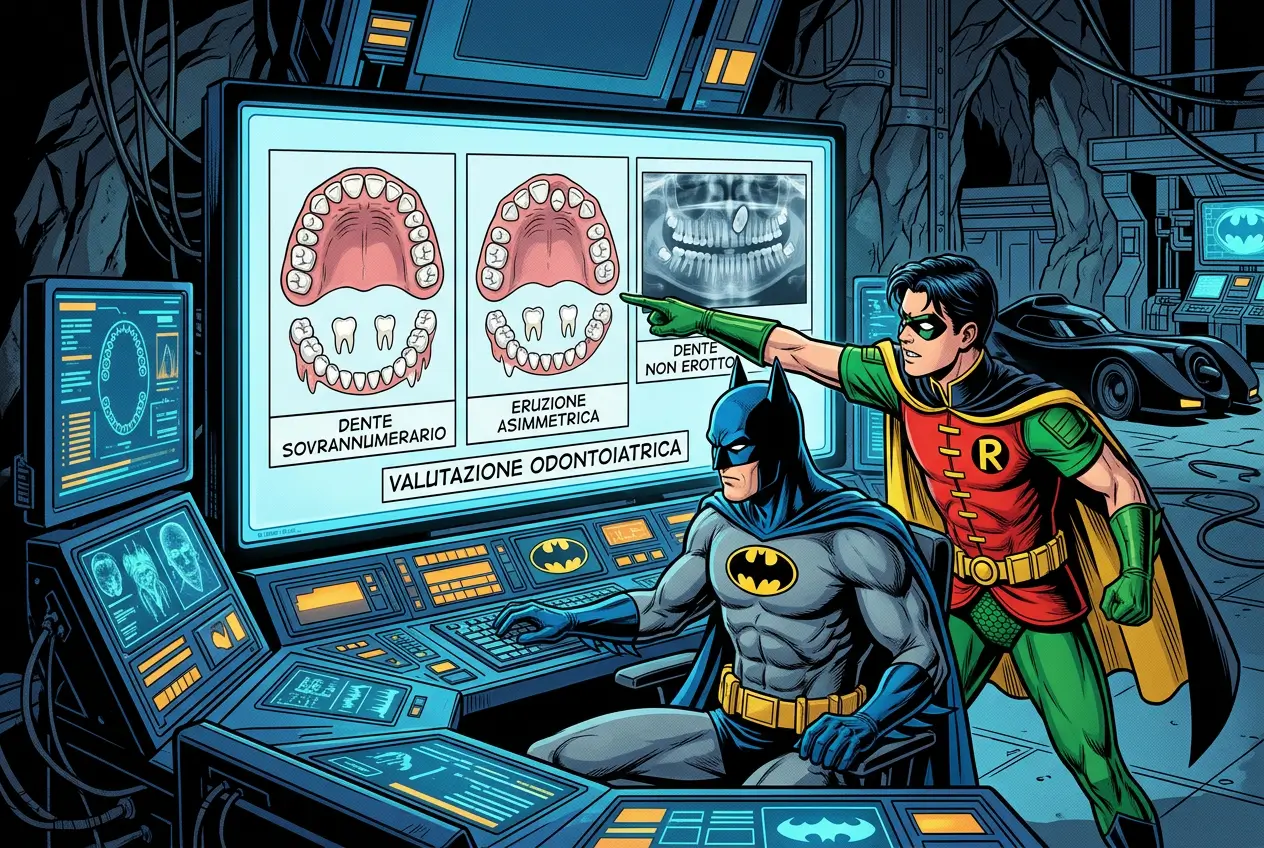
Signals that can make an extra tooth suspect
The most obvious signal is an additional element, often small or unusual, which appeared between or behind the teeth. Other clues are a permanent incisive that does not stop when the corresponding contralateral is already present, a milk tooth that remains long, a persistent central space, rotations or unexpected movements.
Many overnumbered teeth do not cause pain and are discovered during a control or radiographic examination performed for a precise question. Inflator, secretion, pain or trauma on the area require an evaluation, but their absence does not exclude that the element interferes with eruption.
Over-numbered tooth, late eruption and dairy holding
A delayed permanent does not automatically mean that there is an extra tooth. Eruption may vary physiologically or be hampered by lack of space, abnormal position, previous trauma, odontoma or other conditions. Also a detained milk tooth can be consequence, not cause, of the underlying problem.
Comparison with the tooth of the same type on the other side of the arch, the dental age and the sequence of permutations help to direct the diagnosis. Extract independently or force a milk tooth does not necessarily free the path of the permanent and can cause pain or injury.
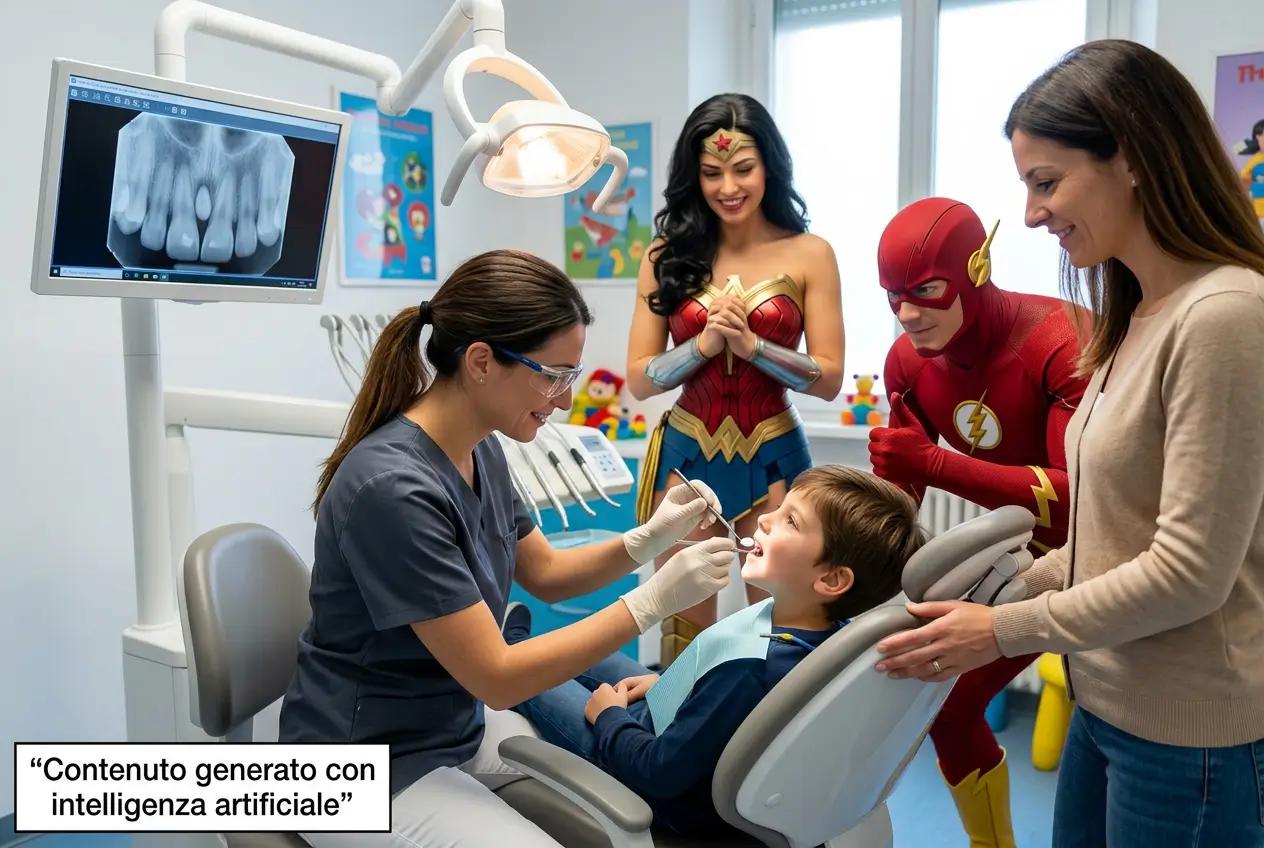
How clinical and radiographic evaluation takes place
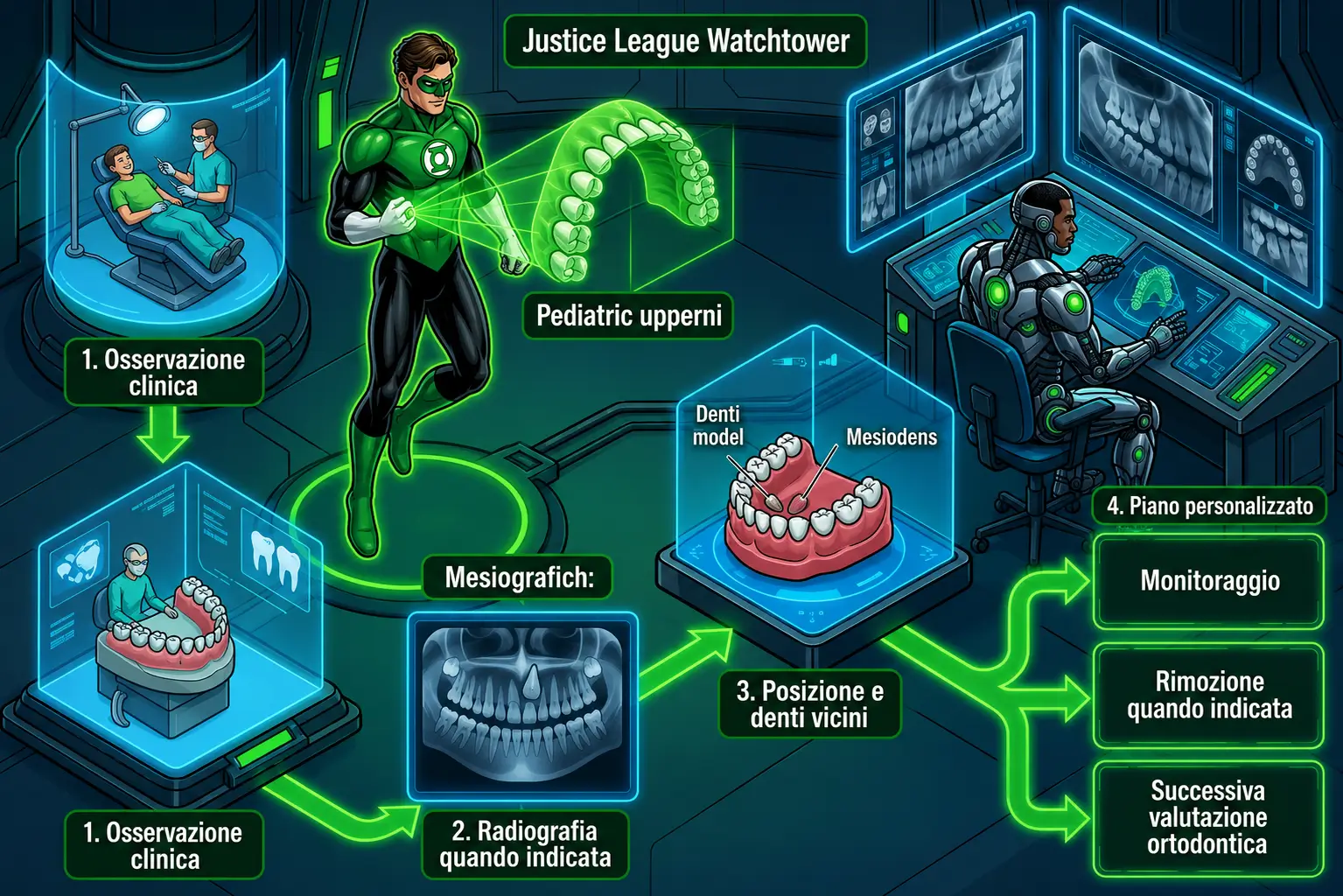
The visit reconstructs eruption times, familiarity, previous traumas and changes observed. The dentist counts the elements present, evaluates symmetry, spaces, mobility of milk teeth, position of the incisors and conditions of gums and mucous membranes.
When the clinical examination does not clarify the location and relationships, a targeted X-ray can confirm presence, orientation and proximity to the roots. The type of image must be chosen according to the question and with the minor exposure reasonably necessary. The AAPD information on development teeth recall the importance of examination, appropriate documentation, differential diagnosis and sequential plan.
Possible paths for overlapping teeth
Clinical monitoring over time
If the extra tooth does not hinder eruption, it does not damage neighboring structures and does not create functional or hygienic problems, the professional can propose programmed controls. Monitoring is not abandonment: it provides parameters and times defined according to growth.
Removal when an indication exists
Extraction can be evaluated when the overnumerary blocks or deviates a permanent, reduces space, damages a nearby tooth or presents other complications. The moment depends on the position and the radicular development: intervene immediately is not always the best choice.
Expectation and guidance of spontaneous eruption
After the removal of the obstacle, a permanent tooth can sometimes spontaneously erode if it has favourable space and direction. The control checks progress; there is no identical time for all and the absence of movement may require a new assessment.
Permanent tooth orthodontic recovery
When spontaneous eruption does not occur or the tooth is disallined, it can be indicated to create space and guide it orthodontically. Technique and time depend on age, location, roots and occlusion; fixed devices and other solutions are not automatically interchangeable.
What to do at home and what mistakes to avoid
It is useful to note when the milk tooth fell and when the corresponding permanents appeared, without turning the eruption tables into rigid deadlines. Periodic photos can document a change, but do not replace visits and diagnostic images when indicated.
You don't have to try to push, row or extract an extra item, or use elastics or devices purchased online to close a space. If pain, swelling, secretion, trauma or difficulty to bite, it is prudent to contact the study and do not administer drugs without medical indication.
Evaluation of overlapping teeth at Studio STERE di Lecce
At Studio STERE, in Via Giovanni Boccaccio 19 C/D/E in Lecce, the evaluation considers development of teething, present elements, spaces and eruptive path. When necessary, the case may supplement pediatric dentistry, radiographic diagnostics and orthodontics, without anticipating treatment before diagnosis.
Dr. Nicolò Stefanelli and Dr. Rosanna Renò have gained more than ten years of experience in the dental sector in Italy. The Studio remains open all summer until 31 August 2026, with visits to be agreed with the secretariat.
Among the verified services of the Firm is the orthodontics with transparent aligners; Invisalign® is one of the systems used when orthodontic evaluation indicates its use. In children with oversized teeth, however, the priority is to define eruption, space and growth: a liner does not remove an obstacle included and does not replace diagnosis. Read morepediatric dentistry.
Frequently asked questions about overlapping teeth in children
Should an overnumerary tooth always be removed?
No. The choice depends on location, effects on eruption, hygiene, symptoms and risk for neighboring teeth. Some elements can be monitored; others require removal at a planned time.
What is a monthodens?
It is an overnumbered tooth located in the area between the upper central incisors. It can be visible or included and can be associated with eruptive delay, rotation or space between the incisors.
Is X-ray always necessary?
Not in any control, but it is often useful when the extra tooth is not visible or it is necessary to define relationships and orientation. The exam is chosen only if it can answer a concrete clinical question.
After removal the permanent tooth drops alone?
It can happen, especially if there are favourable space and direction, but it is not guaranteed. Age, position and radicular development influence the possibility and timing of spontaneous eruption.
When should I book a check?
When an extra tooth appears, an incisive bursts long after the contralateral one, a milk tooth remains beyond the permutation waiting or shifts, pain or swelling appear.
At Studio Odontoiatrico Stere you can find a complete range of preventive and curative dental treatments.
If you are looking for a dentist in Lecce to improve oral hygiene, prevent caries and gum inflammations or choose home products that suit your needs, the Studio Stere team can accompany you with a customized evaluation. Learn more about Scholarship. it and book your visit to control.
Read more important articles here: Blog
Visit the official website: Study Stereo
Come and visit us: Via Giovanni Boccaccio 19 C/D/E – Lecce
Contact us now for an evaluation.
Follow us on our social media:
Article written by Dr. Nicolò Stefanelli – Dentistry
Continue reading
Conoid lateral incisive: how to assess shape, space and restoration | Dentistry study Stere
Pulpotomy in the adult permanent tooth: when to store part of the pulp | Dentistry study Stere
Tooth moved after a shock: because lust requires an urgent visit | Dentistry study Stere
Odontoma: when an obstacle prevents a tooth from popping | Dentistry study Stere